Tuesday, March 26, 2024

Orcs and goblins as enemies: V.V. Edition

The thing about the evil "races" debate is that I actually see a lot of potential in goblins and orcs as enemies, but not with the way they are presented in most D&D settings. Those feel incredibly icky for a lot of reasons, most of which y'all are tired of reading about.

So, in the interest of keeping them as enemies while excising the ick, here's some quick lore from my campaign setting!

DROWNED IN HELL

When people are drowned in the infernal waters of the Abyss, they emerge as orcs. Well, adults do. Children emerge as goblins, instead.
The reason why both orcs and goblins are so "violent and warlike", then, isn't biological predeterminism. They're basically possessed by infernal rabies.

And the best part is, they can be cleansed. Purging the Infernal Ur (tainted magic) that corrupts orcs and goblins alike is a campaign-long goal, and not an easy task at all. But it's doable.

If/when the PCs or NPCs manage that, the untainted orcs and goblins won't be called by those names anymore. They'll cease to be driven by rage and cruelty. They'll recover a lot of their former memories and personalities, and they won't need to drown others in the Abyss to increase their population anymore. For all intents and purposes, this will be the birth of two new Lineages of the Folk, embraced and treated as such.

That won't stop new orcs and goblins from being made in the Abyss, however. Shock troops are always useful. Callously killing them, however, won't be so easy anymore. That's the power of an informed decision.

THIS POST BROUGHT TO YOU BY...

So, there are three main influences for this take on orcs: the Super Mutants from Fallout 1, zombies, and the Deadites from Evil Dead. The "dunking regular people in evil soup" aspect of it comes from the Super Mutants, obviously, and the possibility of a cure comes from zombies. Deadites were the key ingredient, though, with their penchant for self-harm, mindless abandon, gratuitous cruelty and thirst for violence being an inspiration for the infernal angle of it all, as well as a way of keeping what makes orcs cool without the offensive bits.

As for the goblins, most of the above also applies, with the addition of a wonderful blogpost by @sandromaycry. It's a must-read if you're at all interested in different interpretations of fantasy species.


Sunday, March 24, 2024

Werewolf: The Apocalypse and the impact of flawed representation

I have conflicting feelings about Werewolf: The Apocalypse.

As a mixed-race Indigenous person who wasn't raised by their people, Werewolf was my first contact with a true attempt at representation for Indigenous cultures. It wasn't entirely positive, nor was it responsible, sensible or accurate, bordering on the noble savage racist trope, but given that everything else treated us like less-than, it mattered.

Seeing my ancestry being portrayed as this interesting, vibrant and deeply spiritual collection of cultures sparked an awakening of sorts.

Now, I grew up deeply ashamed of my skin and my features, even resenting the fact that I didn't look like the White protagonists I was force-fed by Hollywood throughout my childhood. My hair didn't look like everyone else's, and no one knew how to cut it properly. My eyes were "too slanted", and I constantly had to endure jokes about Japan, a deeply racist practice here in Brazil. I was often told to avoid the sun so my skin would look whiter and I would "fit in" better.

I didn't want to be an Indigenous person. I felt Othered, alone, isolated. But Werewolf: The Apocalypse, with all its many, MANY flaws, somehow helped me see just how deep, powerful and beautiful my ancestry is.

In spite of all its faults, WtA was the push I needed to get in touch with my roots. After years of research and healing, I started to notice something funny. I no longer felt ashamed of what I looked like and of being who I am. On the contrary: I was proud. My skin is beautiful. My culture is rich, diverse and full of wonder.

Embracing the spiritual side of my heritage was an act of self-love, too. I was forcibly inducted into Christianity as a child, and that was a traumatic experience, to say the least. I closed myself off to anything that felt remotely religious due to that trauma for at least half my life. But now I know where I come from. I appreciate it. I am empowered by it. I know who's looking after me, and I trust and appreciate their protection.

And if I hadn't bought Werewolf: The Apocalypse on impulse when I was 17, I'm not sure this is where I'd be today.

But I can't talk about WtA without mentioning its recent controversies, which range from plagiarism (including the tracing of a Maōri activist's likeness and sacred Tā moko) to a toxic, oppressive work environment detailed by J.F. Sambrano in harrowing detail here. Werewolf: The Apocalypse has never been perfect, but these were brand new lows.

So, how do I reconcile WtA's issues with the massive impact it had on my life? Not easily, I suppose. I will forever be grateful for that first push, and Werewolf: The Apocalypse will always have a place on my shelf as the first TTRPG I ever bought, but I can't and won't endorse its dark side.

Still, the fact of the matter is that representation always matters, no matter how flawed.

It can save lives.

It probably saved mine.

Wednesday, February 21, 2024

Adding Procedures & Random Tables to Vampire: The Masquerade, Part 3: Court Creation & Faction Play

You can't have courtly intrigue without a court, and the truth is, Vampire: The Masquerade barely provides you any tools to create one. Time to change that. While part 1 of this series gave you the tools to create a city of your own and part 2 made it easier to populate it, part 3 is where your sandbox will truly come to life. We'll start from the very bottom, diving into the personal connections that weave webs of intrigue and moving up to coteries before finally exploring some procedures and mechanics for faction play.

THE TIES THAT BIND

Every important NPC should have three personal connections to other NPCs (or even the PCs): one with a powerful figure, one with a coterie-mate, and one with someone from a different faction. At least one of those relationships needs to be negative, and at least one needs to be positive. Roll or choose on the d66 table below.

Here's an example:

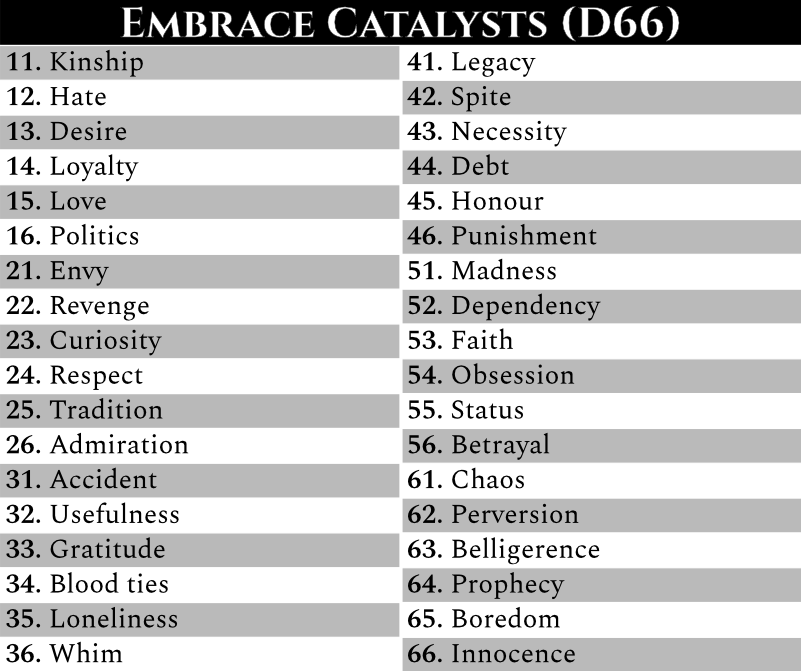
Vincenzo Vallone is a Hecata fledgling with the Thrill-Seeker Archetype. He is just and greedy, favouring trendy fashion, and he craves revolution. He was a disgraced gangster before the Embrace, which was an act of hate. His appearance is marked by thick hair, venomous eyes, and his friendly tone.

Figure of power: He is a thrall to his sire, Giancarlo Putanesca, entrapped by a full blood bond.
Coterie-mate: Vincenzo is indebted to Sniffer, a Nosferatu detective, who welcomed him into their Anarch coterie.
Inter-faction connection: The Toreador Prince, Alanis Whitehall, considers the fledgling an inconvenience, as his clan's very presence is unwelcome in her city.

Establishing these relationships can be tedious, but the payoff is worth it. Once you know who a character's enemies and allies are, it becomes a lot easier to involve them in your city's conflicts. If anyone threatens Sniffer, Vincenzo will be there for him. If the PCs need support against the tyrannical Prince Whitehall, the Hecata fledgling may be willing to stand with them. Instantly gameable, right?

Do note that this isn't meant to be the first step of court creation; it's better to do this once you've already generated all coteries, at the very least. The only reason we're discussing personal connections before coterie creation and faction play is scale — as in, it feels more natural to start at the personal level before moving on to the big stuff.

COTERIE CREATION

Before we start working on your city's coteries, let's get one thing out of the way: while PC coteries should always strive to have functional relationships between all members (as Vampire is still a collaborative storytelling experience, in spite of its themes), the same isn't necessarily true of NPCs. A little inner strife can do wonders for making NPC coteries feel alive and vibrant.

The first thing you should do when creating a coterie is decide its size and its political importance. Naturally, I made a table to help you out with that. Roll or choose away!

Once that's over and done with, it's a good idea to find what the coterie's purpose and focus is. The table below should help you with that, but if you want a coterie to be something else that isn't included in the table, no biggie! As long as there's common ground and/or a shared goal between the coterie's Kindred, it's all good.

And that's it! You can now start creating the individual members of each coterie. My Perchance generators can help you with that, and part 2 of this series goes more in depth into that process, too. If you're following the tables and procedures from part 1 while creating your sandbox city, it's a good idea to stay below (or at least around) the maximum number of Kindred that can be safely sustained by your city's population, but overpopulated and underpopulated cities can both be very interesting, too.

FACTIONS 101

Credit where credit is due: these mechanics were heavily inspired by Mindstorm's blogpost on the subject, as well as Remember Tomorrow's faction mechanics. It's a remix of those, really, with a bit of tailoring for Vampire. 

Now, "faction" is sort of a loaded word when it comes to Vampire: The Masquerade. It could mean anything from the sects, to blood cults and even powerful coteries. My personal definition of "faction" includes all of those things and more, as a politically-aligned group of people (or Kindred) who share the same goals. Ideally, you should only turn a group into a proper, statted out faction if they hold at least some sway over the city, or if they have the potential to. Otherwise, they're just a regular coterie or group, instead of a faction.

FACTION ANATOMY

When developing a faction, you should start by looking at your city's lore, its Domains and their rulers, the main coteries and interesting connections between NPCs. Following the procedures from part 1 will automatically give you a few factions to start with, but if you're only interested in faction creation, you can roll or pick on the faction table¹, using the Appetite table to find a goal for your faction. 

Once you have at least an idea of what the faction is and what they want, you're ready to stat it out. Giving it a cool nickname/title is always nice, but that's optional. Each faction is comprised of three Fronts: Warfare, Influence and Capital. They each have an associated d10, which is what you'll be rolling during faction play (more on that later). Faction strengths and weaknesses are represented by Assets and Flaws, respectively, which can add Advantage or Disadvantage to certain faction actions (and that works exactly like you expect it to work).

Here's an example of a faction stat block:

• The Broken Tower (Camarilla offshoot)

Members: Prince Alanis Whitehall, Paris Johnson, the Sheriff, Daisy Mae and Wilhelm, the Harpies, and Primogens Wayne, Callum and Jazz.
Goal: The complete subjugation of every other faction in the city.

Fronts: Warfare [-1] Influence [0] Capital [0]

Assets: Popular Elysium [Diplomacy], Blood Trafficking [Bribe]
Flaws:
Weak Sheriff [Attack], Unlikable Prince [Recruitment]

Don't worry about balance. Kindred society is unfair by design, so why should faction play be fair? If you feel like a faction should be far stronger than the others, then give an Asset to each of their Fronts; as long as they still have a Flaw, that's peachy keen. If you feel like a faction should be weaker, stat it with several Flaws and perhaps a -1 on a Front or two. When in doubt, use the fiction to dictate the stats.

FACTION ACTIONS

Each Front can perform three distinct actions, as seen below.


Warfare actions are invariably offensive, representing direct attacks against enemy forces and strongholds, strategic surveillance of their movements, numbers and plans, and the underhanded destruction of their troops, equipment and bases. If the Sabbat storms an Elysium in the middle of court, they're launching an Attack against the Camarilla. When they use an infiltrator to spy on the Prince, they are engaging in Reconnaissance. If they plant explosives in the Sheriff's haven while he's out, they're partaking in Sabotage.

Influence actions cover key aspects of social maneuvering, such as forming alliances, bolstering the faction's ranks with fresh blood and spreading (mis)information through the city. If the Camarilla appoints a dissenting Toreador ancilla to the Primogen, they are using Diplomacy. If they allow each Kindred on the Primogen council to Embrace new childer, they are starting a Recruitment drive. When they spread footage of the Anarch Baron mistreating a fledgling, they are disseminating Propaganda.

Capital actions concern the management and application of a faction's resources, like investing in worthwhile endeavours, acquiring any equipment, building or services deemed useful, and buying favours, information or even loyalty. If the Anarchs offer to lend some of their guns to the local Duskborn, they're making an Investment. If they buy a huge supply of blood bags from a neighbouring city, they decided to Procure it. When they pay the neighbourhood's security firm to turn a blind eye to their comings and goings, that's obviously a Bribe.

ROLLING AND REWARDS

When one of a Front's actions is used, roll a d10. A result of 6 or above is a success, while a result below 6 is a failure (the consequences of which we will discuss in a bit). Before a faction executes an action, though, you should first determine which Reward they want, selected from the list below.

Rewards should always be rooted in the fiction. If a faction is trying to neutralize a Flaw, then that needs to be reflected in the fiction somehow. If you can't justify how a certain action results in a specific Reward, then perhaps it would be better to choose a different, more fitting reward for that action.

Failing a roll doesn't result in catastrophe; rather, the faction simply doesn't get the Reward they were looking for, and the fiction should reflect that. Sometimes, a failed attempt at assassinating the Prince's favourite childe can be even more exciting in play than a success.

GAME OVER, MAN

If one of a faction's Fronts ever falls below -3 and that Front already has a Flaw, then that faction is eliminated from faction play. That doesn't mean they simply vanish from the fiction, although that is a possibility. What this is meant to represent is that they simply don't have enough political power to keep playing with the big kids. The faction's remaining members could opt to join other factions, perhaps even becoming prime recruitment targets. 

Or, you know, they could all meet the Final Death. Whatever tickles your fancy. 

QUICK REFERENCE

• To execute a faction action, choose a Reward and roll a d10
• If the Front used for the action is damaged, subtract the modifier from the result
• If the result is below 6, the faction simply doesn't get the chosen Reward

• When a Front suffers damage, the faction adds -1 to any further rolls with that Front
• Factions can only remove damage from Fronts without Flaws
• Fronts can only be damaged up to -3
• If a faction's Front is damaged at -3 and it already has a Flaw, the faction is eliminated

• Relevant Assets grant Advantage (roll 2d10, keep the highest die) to an action type
• Each Front can only have one Asset
• Assets can only be destroyed when their associated Front is already damaged

• Relevant Flaws grant Disadvantage (roll 2d10, keep the lowest die) to an action type
• Each Front can only have one Flaw
• If a Front doesn't have a Flaw, the faction can take one to negate incoming damage
• It is impossible to remove a faction's last flaw

FACTION PLAY

There are a few ways to go about faction play, and none of them are wrong, per se. Call it a matter of taste.

The first is keeping faction play as a side activity for the Storyteller, something they do between sessions to spice things up in the city, allowing a few factions to pick an action. There shouldn't really be any hard rules to which factions should get an action, though the fiction will often inform these decisions. If the PCs are part of a faction taking an action, you can give them the option to support that action. They count as an Asset for the purposes of that roll.

The second is allowing the players to take control of a faction, while you control the others. Their PCs should ideally be part of the faction they're controlling, in order to avoid conflicts of interest. If you go with this option, you should probably engage with faction play either before or after actual play (that is, at the start or end of the session). You could do both, too. Whatever works for you and your troupe!

The third is a spin on the second; rather than controlling a single faction as a group, each player gets to pick one faction. Conflicts of interest are probably going to be inevitable, but this has the potential to be loads of fun! Other than that, this should work exactly like the alternative above.

FINAL NOTES

On occasion, it might not be immediately clear which action fits what a faction is attempting in the fiction, and the best way to ascertain that is by looking at their desired rewards. Going back to one of the action examples, if the Anarchs wanted to Develop the Duskborn coterie as an Asset (like, say, Duskborn Shocktroops), then they wouldn't really be Investing, they'd be Recruiting. But if they wanted to Accomplish something in the fiction (like diverting the Camarilla's attention towards the well-armed Duskborn), then that's definitely an Investment.

Faction Fronts, Assets, Flaws and even goals are inevitably going to be altered in the fiction due to the PC's actions outside of faction play, and that's okay. Make any necessary adjustments and move on. Faction play is meant to be an add-on, not the main course, and anything that happens during actual play takes precedence over it.

¹ The offshoots from the faction table are meant to represent local schisms — rolling a Camarilla faction and a Camarilla offshoot, for example, could represent a city contested by two Princes. This could also be interpreted as deviations from sect norms, resulting in things like Anarchs with wildly different political structures (think a Parliament rather than a Baron) or unusual traditions.


Wednesday, February 14, 2024

Adding Procedures & Random Tables to Vampire: The Masquerade, Part 2: NPC Creation

It's finally time to dive into NPC creation! As with part 1, this involves a lot of tables, so much so that I even made some Perchance generators to help facilitate the process. You'll find those at the end of the post, but to be honest, I feel like they might actually be the main course. That's how happy I am with them.

Without further ado, let's Embrace some Kindred!

KNOW THYSELF

I'm thoroughly biased towards Vampire: The Requiem's virtues and vices, so much so that I made a table inspired by those a big part of my city creation process. While working on NPC creation, however, I noticed 12 virtues and 12 vices weren't enough, so I added a few more and rounded both up at 20.

This part of the process is meant to imbue each character with an admirable trait and a fatal flaw, something that the players can easily pick up on, and can act as a guide when you're unsure of what a certain character would do.

So, yeah, let's start by rolling (or choosing) a virtue and a vice for your NPC!


One big complaint a lot of people had regarding virtues and vices, though, was that they were a lesser form of the Archetypes (used for Nature and Demeanor) from Vampire: The Masquerade. While I don't necessarily agree with the sentiment (as those could be quite restrictive), I think they can be complimentary to each other.

It's up to you how important these are gonna be to your NPC's personality and whether you're gonna use the Nature/Demeanor mechanics, but I'd personally rather keep Archetypes as the "face" the characters present to the world and the way they interact with it, rather than a mechanical thing or an intrinsic, deep part of who they are. Virtues and vices work better in that regard, IMO.

In any case, let's pick or roll an Archetype on the d66 table below.

You can find full descriptions for these on V20, but you don't really need to, as they're all evocative enough.

BECOMING

Virtues, vices and Archetypes are plenty useful even when you're not creating vampires, but we should get the specifics out of the way before we go any further. Two of the most important facets of Kindred existence are age and the status that comes with it, and, you guessed it, there's a table for that.

This table can also be used with a d4 or a d6, ensuring lower power levels.

Another key aspect of Kindred society is lineage, and it's time to find out what clan chose your NPC. We're gonna determine the reason behind their Embrace later on, but for now, let's roll or pick a clan. The table below can also be found in part 1 of the series, but it's included here for ease of access.

To narrow the results down to the main clans, roll a d12 instead of a d20.

So far, we know the character's biggest virtue, their darkest vice, how they present themselves outwards through their Archetype, how old they are and what clan they belong to. What we don't yet know is what their place in the world used to be before the Embrace, but we're gonna fix that. First, roll or pick a flavour for their concept.

Then, if your character is a fledgling, a fresh neonate, a neonate or a young ancilla, determine their concept with the d66 table below.

If your character is too old for those concepts (that is, if they're an older ancilla, a pretender elder, an elder or a methuselah), determine their concept with the d66 table below.

I tried to make both the flavours and the concepts as dynamic as possible, because let's face it, boring concepts aren't usually the best ingredients for cool NPCs. Stuff like a respected activist or an inexperienced assassin should be immediately gameable, and that's always the goal!

It's as good a time as any to uncover what motivated the character's Embrace, which brings us to yet another d66 table. You know the drill.

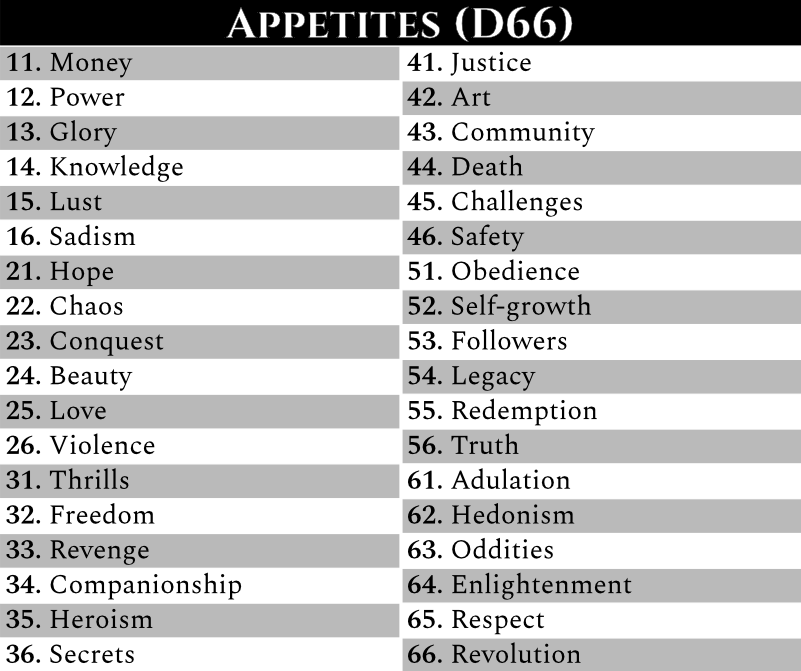
And with that, there's only one table left before we move on to the last part of this NPC creation process: appetites. These are essential for Vampire: The Masquerade, as each and every NPC needs to want something, and those needs and wants will form the crux of conflict in many a chronicle. Note that they're deliberately vague, and leaving them for last was a conscious decision, as the other results can help you interpret what exactly your NPC's appetite means for them.

STYLE WITH SUBSTANCE

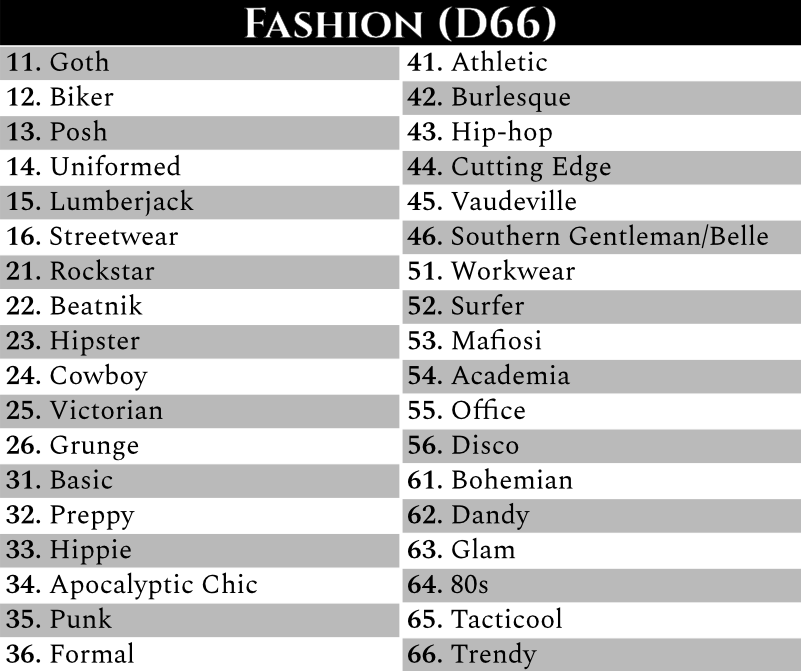
At this point, you already have a pretty well rounded character, but what's substance without a little style? The fashion table below should help your NPCs stand out a bit. Some combinations can be admittedly hilarious, but the famed Banu Haqim methuselah who fancies Disco a little too much is an instantly recognizable character. It's your choice whether to lean on that or not, though, and re-rolling is always an option.

I also made some d20 appearance tables (six, in fact), but I'm not gonna plaster them here, as this blogpost is already overstuffed with images. You can find them here. Personally, though, I wouldn't use all six for every NPC. I'd roll two or three for each (which is why the tables themselves are numbered 1 to 6), so that your players will get some interesting visual cues to go with the NPC's fashion choices, but not enough to overwhelm them.

That's all, folks! We're done with NPC creation.

CHANCE AND CHOICE

It's important to consider the pros and cons of manually rolling and choosing everything instead of just using the Perchance generators I came up with. If you're in a pinch and need an instant NPC, nothing beats a good generator, no doubt, and if you need to make a lot of Kindred at once, doing everything manually would be a royal pain. But there's a kind of art to curating results, one that can lead to some pretty remarkable NPCs. Personally, when time isn't of the essence, I will always choose to do everything myself. And yet, there's a certain joy to being surprised by the complete randomness created by Perchance.

VAMPIRE MAKING FACTORY 3000

So far, I have created three different Perchance generators for Vampire: The Masquerade, two to automate the process of NPC creation (one for younger vampires, one for older licks) and one for creating Domains and their rulers (a key aspect of the city creation process). You can find the NPC generator for younger NPCs here, while the one for older Kindred is available here. Lastly, the Domain generator is found here.

Fair warning: this was my first time working with Perchance, so you might stumble into some funky issues. If that happens, please let me know so I can fix it! <3

Anyway, I hope the results speak to you as much as they speak to me.


Sunday, February 4, 2024

Adding Procedures & Random Tables to Vampire: The Masquerade, Part 1: City Creation

I've been complaining about Vampire: The Masquerade's dearth of meaningful procedures for a long time, as the game (regardless of edition) sorely needs them. But rather than keep complaining, I decided to take matters into my own hands, starting with city creation. Fair warning: this might turn into a long series, or it might fizzle out after a couple of entries. 

Now, I don't know about you guys, but as a fan of sandbox campaigns, I'm severely disappointed in the tools Vampire provides for those, particularly when it comes to creating your chronicle's city. I've lost count of how many chronicles never even got off the ground because I got burned out during the prep stage. The procedures and tables we'll go through below were designed to fix that. 

Before we get started, though, credit where credit is due: d4 Caltrops made a terrific blogpost regarding city crawls, which was a huge influence on all of this. In fact, we'll even use one of the tools I found on the aforementioned blogpost. You guys should definitely check it out, as it could prove invaluable to your OSR campaigns!

Chris McDowall's amazing Electric Bastionland procedures for borough creation have also been a big inspiration here, and I consider them the gold standard when it comes to this stuff.

BLOOD RED STREETS

The first step here is finding a city map. You can generate your own easily with ProbableTrain's City Generator, and watabou's Medieval City Generator, with a few tweaks, works great for modern cities, too. Of course, you can absolutely use an actual, real world city for this, although that will have an impact on some steps. 

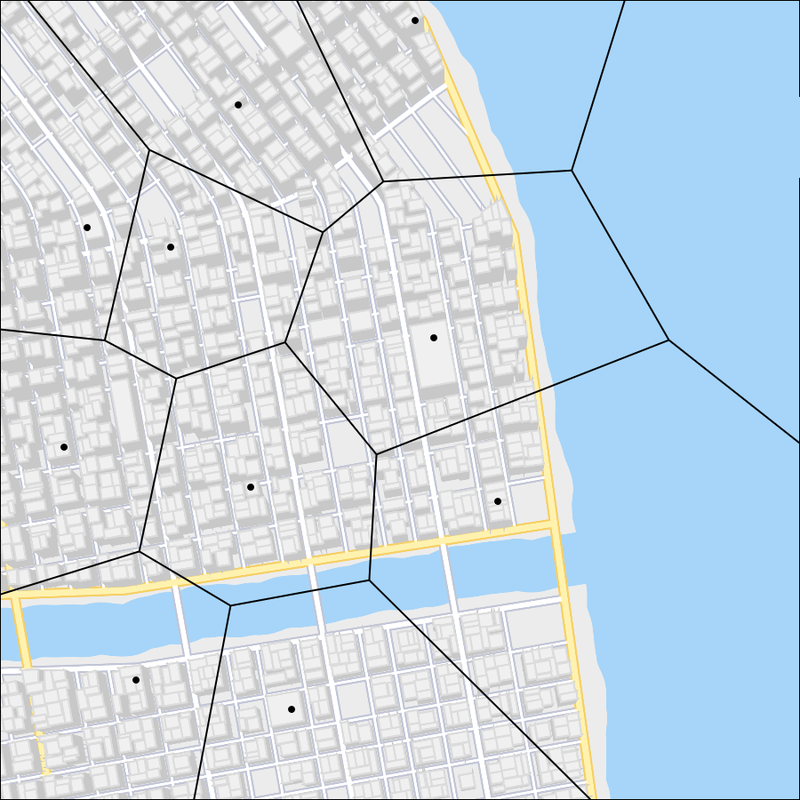
Once you have a city map you're satisfied with, you'll need to run it through Cfbraz's Voronoi Diagram Creator, though one could also use Gimp's mosaic generating filter for this step, or even manually draw over the map. If you choose to use the Voronoi Diagram Generator, you'll need to upload your map to a website of your choice, and link it on the generator. Its configs should look like this:

Afterwards, you'll want to click on Clear all sites. And then it's a simple matter of clicking on different points of the map until you've generated at least 8 sections. It might be a good idea to position your clicks on buildings, streets and areas that look interesting, as the resulting dots will be an important part of your city.

Here's an example of a map generated with the process above:

With this process, we've delineated the city's most important Domains, which we will flesh out later on. At this point, you might want to add numbers, cool titles or even neighbourhood names to each Domain with an image editor of your choice, but that's completely optional.

HISTORY WRITTEN IN BLOOD

Now that the technical part is done, we can start breathing life into the city.

The first thing we'll do is pick the city's themes and mood by rolling on the tables to the right. You should roll twice on each, assigning two results to the city's theme, and two results to its mood; it's your pick, so you can choose to mix and match between virtues and vices, or double down on them.

History is a big part of what makes any city feel alive, and by rolling on the tables to the right, you'll determine when it was founded, and how many significant historic events it's been through (which we will also generate later).

With that done, it's time to roll for the city's population, both mortal and Kindred. Do note that this will inevitably result in either under or overpopulated cities, Kindred-wise, so you may opt to roll once and use the same result for both tables.

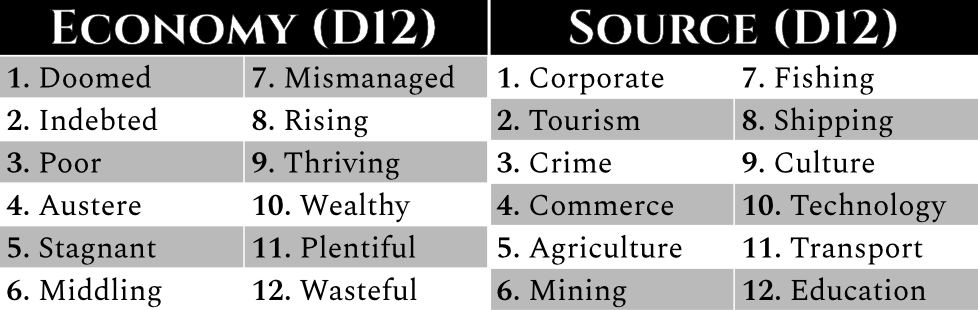
The next step involves determining how the city's doing, economically speaking, and what its main source of income is. You can diversify its income by rolling a few more times on the Source table, and I would actually recommend doing that, if your city is fairly old and/or particularly big. 

And to conclude the mundane side of things, let's take a look at the historic events table (Kindred history will be dealt with later). You should roll or pick as many events as determined by the city's age, though nothing is stopping you from rolling or picking more.

WE RULE THIS CITY

By now, you should have at least a decent foundation for your city, which means it's time to flesh it out and to explore the Kindred side of things.

The table to the right will help you determine which faction rules the city, but you may want to add a couple of enemy factions, too. Of course, if you'd rather focus your chronicle on a single faction, rolling once is enough.

The city's main historic events have already been established on the mortal side of things, and now it's time to do the same for the Kindred. The city's age will also determine the number of events you should roll for. Make sure to spread these out throughout the decades, reflecting Kindred society's stagnant longevity.

We have finally reached my favourite part of this thing: Domains! First, pick an area on your map, then roll twice on the d66 table below to establish its traits. These should help you give an identity to each Domain, which can prove invaluable to naming the area, be it with a proper neighbourhood name ("Barrowtown"), a Kindred-given title ("the Big Empty"), or an evocative nickname ("Desolation Row").

All Domains need a complication, something that gives them an edge and makes them gameable. The table to the right will give your Domains an interesting issue, something your players can interact with, and perhaps even solve. One complication is enough, but adding more can illustrate just how bad things have gotten. 

On the flipside, there needs to be a reason why someone decided to claim the area as their Domain, and that's what you'll determine with the help of the benefits table. One is enough, as with complications, but particularly desirable Domains could (and perhaps should) have more.

If your city is home to multiple factions, you can either roll on the factions table to determine which one rules each Domain, or you can simply pick one. The clan table below can be used to decide the clan of the Domain's ruler, and it may come in handy in a variety of situations. 

To narrow the results down to the main clans, roll a d12 instead of a d20.

Each Domain has a little dot, which represents its central point of interest. While it doesn't necessarily need to be important to the city's Kindred, it works well as a "seat of power" of sorts for the Domain's ruler. To create a point of interest, you should roll twice on the d66 Traits table from before, and once on the table to the right. That will give you a location for your point of interest and some much needed flavour, too.

If you rolled a landmark, fret not! Here's a table to help you with that. Landmarks tend to be particularly relevant to a city's identity and history, so tying it to historic events or even its economy could grant it more weight. 

And that's it for Domain creation. Ideally, we should also generate the bloodsucker who claims the area as his property, but I'll save NPC creation for part 2. Time for some final considerations!

LIVING IN THE REAL WORLD

It should be pretty clear by now that this process was designed with the intetion of creating fictional cities, but can it be applied to real cities? I think so, but the process is significantly different for those. Rather than rolling on the tables above, you'll be picking options that match the city in the real world. Or maybe not! It's the World of Darkness, places are allowed to be different. The Kindred side of things should be a lot more relevant, in any case.

NOTHING BUT LEFTOVERS

Two tables, Climate and Region, didn't end up making the final cut, but they can still be useful in the right circumstances. They were omitted due to being way too general to add much value to the process, and the Region table goes into a bit of a hot button issue. As in, the omission of Africa and Asia was not intended as erasure, but rather as a consequence of Vampire's deeply problematic mishandling of both regions in the lore. You can still check those tables out, but I don't consider them part of the city creation procedure we've delved into here.

I'll end the post by letting y'all know that I've already done a bunch of work on the NPC creation procedures, and that I'm considering making a "city sheet" of sorts where you can store all this stuff. 


Tuesday, January 23, 2024

Diplomacy procedures, bonding with NPCs and dating sims

My favourite thing about OSR and PbtA games is the way both of those support me as a GM/Master of Ceremonies with tangible mechanics, lessening the burden and the responsibility of choosing everything myself. Random tables, moves, principles, procedures — they're all incredibly useful when it comes to adjudicating what happens next. With that said, most OSR-leaning games leave a lot to be desired when it comes to diplomacy, negotiations and social interactions in general. 

Here's a little something I came up with to help with that.

WORKING ON THAT ATTITUDE

Reaction checks have always been the most important tool for social interactions in the OSR space, as far as I'm aware, and I'm not about to throw away the baby away with the bathwater. Reaction is great, though I feel like there's a lot more that can be done with it — like, say, Diplomacy challenges. But I'm getting ahead of myself. The term Reaction implies something far too immediate and transient, so let's swap it for Attitude, first. I swear it's not a meaningless change, though! Pinky promise. 

Now, let's look at a basic Attitude table I put together for our Attitude checks.

It's a lot like a Reaction table, and that's on purpose. Like I said, Reaction is great! Now that we have an Attitude table, though, we can go ahead and talk about Diplomacy challenges.

DIPLOMACY CHALLENGES

Rather than being a fixed, immutable thing, Attitude can be altered by Diplomacy challenges, though the PCs will need to offer a compelling argument, a bribe, a promise or even grovel at the target’s feet — that is, any and all forms of diplomacy can trigger this procedure. 

These challenges are comprised of one or more Parley checks. These work like normal Charisma checks, and although I'm partial to roll-under, I'm sure they'd work fine with DCs. Certain NPCs or creatures will react better (or worse) to certain actions, and the GM can apply Advantage or Disadvantage accordingly.  

The exact number of Parley checks one can make during a Diplomacy challenge is determined by the target's initial Attitude, which also influences how much you can sway them; see the table below. 


No matter how many PCs are involved in a particular Diplomacy challenge, the one with the highest Charisma will always make the checks, although the others may still contribute with modifiers and/or Advantage. It's up to preference.

Keep in mind that Diplomacy challenges are not always a possibility. It’s impossible to be diplomatic against NPCs and creatures that are outright Hostile, but even Adverse, Suspicious and Neutral characters may still prove unreceptive to negotiations, as dictated by their natures and/or their current circumstances.

SOCIAL LINKS BY ANY OTHER NAME

Players will latch on to the most unexpected NPCs, so when that happens, it's good to have a way of tracking where they stand with each other. Cue our next procedure: Bonds. In order to track a Bond, we need to establish an NPC's Likes, Dislikes and Wants — that is, something they approve of, something they disapprove of, and something they desire. You can get as specific or as abstract as you want with these, though specificity makes signaling these to your PCs easier.

Whenever the PCs do something that matches the NPC's likes, you can adjust their Attitude positively. Likewise, when the PCs' actions displease the NPC, you can adjust their Attitude negatively. Helping or hindering them with their wants has an even bigger effect on the NPC's Attitude towards the PCs, naturally. For ease of reference, consult the table below.

It is possible to completely break a Bond with an NPC, though that should only happen through particularly serious actions and events. When a Bond is broken, the NPC’s Attitude is immediately changed to Suspicious, and the party will never be able to increase it past Neutral again. 

Some actions may solidify a Bond between the party and an NPC. When a Strong Bond is formed, any and all negative Attitude adjustments are limited to -1. It is up to the Game Master to decide what exactly may lead to the creation of a Strong Bond, but Likes, Dislikes and Wants can act as indicators. Any time a Bond would go above Friendly (that is, over 12), the GM may also decide to turn it into a Strong Bond. 

If a Strong Bond is ever broken, it is permanently adjusted to Adverse. It’s impossible to break a Strong Bond with an Attitude higher than Neutral, no matter how dire the circumstances. Similarly, if a Strong Bond’s Attitude ever drops beneath 9 (Neutral), it becomes a normal Bond instead. It is up to the GM whether it’s possible to turn it into a Strong Bond again.

PFFT, WHO NEEDS PLAYTESTING

I do. No, seriously, I need to playtest this, because right now, it's just a jumble of ideas that may work beautifully, may turn into a huge chore, or may just end up turning my elfgames into dating sims (which would be a plus in my book, tbh). Once I get some mileage out of these procedures, I'll either update this post with the results, or make a new post altogether on the subject. 

Until then, if anyone ends up using any of this, I'd love to hear about it!

And if your campaign becomes a dating sim, please know that I am not sorry.